
Panama Corporation vs Private Interest Foundation (2026 Guide)
Panama Corporation vs Private Interest Foundation: Which structure is right for you in 2026?
Panama has established itself as one of the leading international jurisdictions for entrepreneurs, investors, expatriates and high-net-worth families seeking efficient legal structures for business operations, asset protection, estate planning and international investments.
Among the most widely used structures in Panama are:
Panama corporations
Panamanian Private Interest Foundations
Although both structures offer privacy, flexibility and international usefulness, they serve very different legal and strategic purposes.
Understanding how each structure works —and when to combine them— is essential to building an effective international strategy in 2026.
What is a Panama corporation?
A Panama Corporation, commonly known as an S.A., is a legal entity designed primarily for commercial and business activities.
It is one of the most flexible and internationally recognized corporate vehicles in Latin America.
Panama corporations are commonly used for:
International commercial operations
Holding companies
E-commerce businesses
Holding real estate
Consulting firms
Investment vehicles
International trade activities
Expansion structures for startups
A corporation operates as a legal entity that is independent and separate from its shareholders.
Companies choose Panama corporations for their flexible corporate laws, fast incorporation process, international use, shareholder privacy, territorial tax system and dollarized economy.
What is a Panamanian Private Interest Foundation?
A Panama Private Interest Foundation is a unique legal structure created under Law 25 of 1995.
Unlike a corporation, a foundation is not designed primarily for commercial operations. It is generally used for:
Asset protection
Estate planning
Inheritance planning
Wealth preservation
Confidential ownership arrangements
Family governance structures
A foundation has no shareholders. It is administered in accordance with the Foundation Charter, the Foundation By-laws and the instructions established by the founder.
Private Interest Foundations are widely used by international families, entrepreneurs, investors, business owners and high-net-worth individuals. They are especially valuable for long-term estate planning and succession strategies.
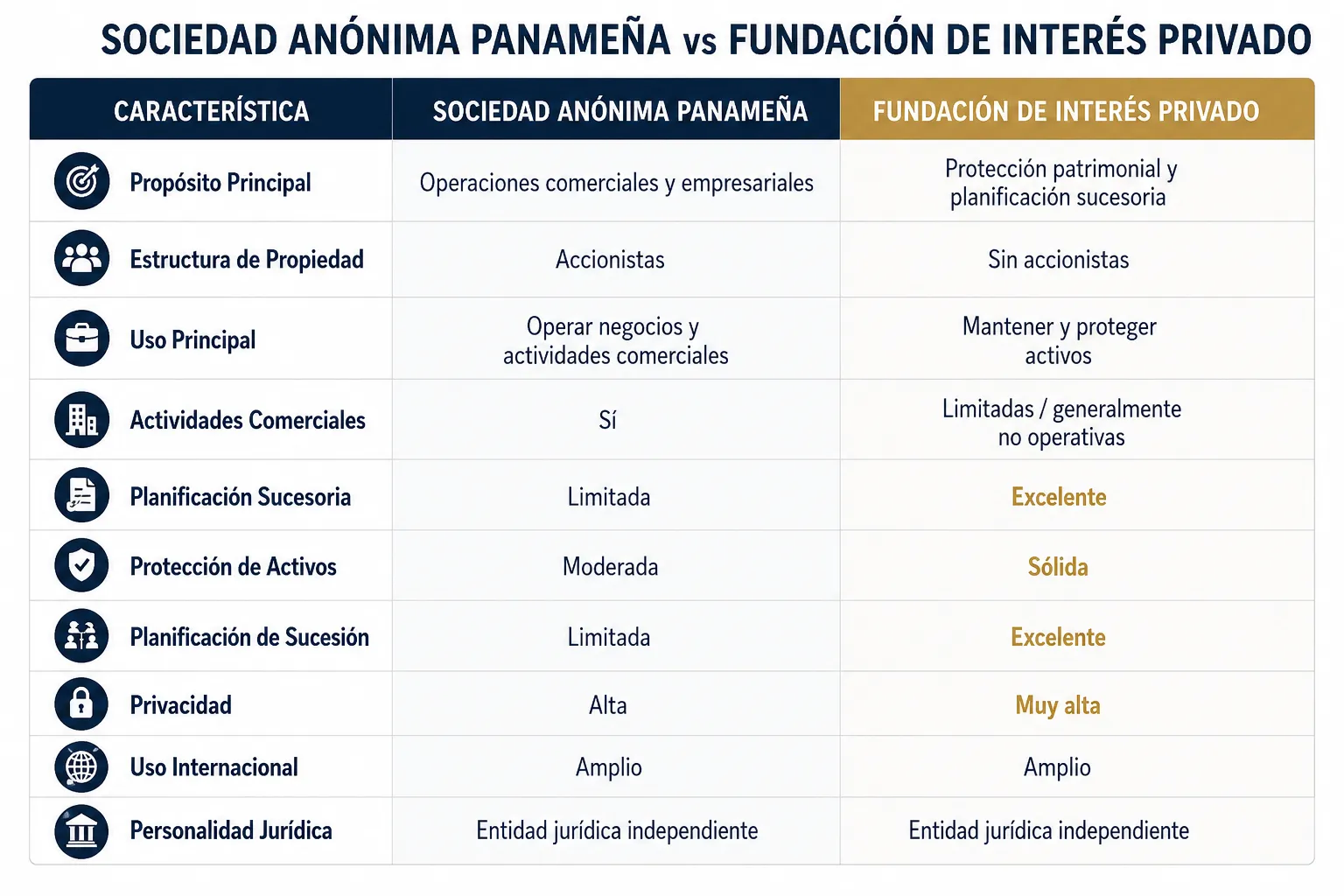
Key differences between a corporation and a foundation
When a Panama corporation is the best option
A corporation is usually the best structure when the goal is to launch a business, invoice clients, operate internationally, hold active investments, open merchant accounts, carry out commercial activities or manage operational risks.
For entrepreneurs and startups, the Panama corporation remains one of the most versatile structures available. Typical examples include SaaS companies, consulting firms, logistics businesses, import/export operations, online businesses and international service providers.
When a Private Interest Foundation makes more sense
A Private Interest Foundation is usually more suitable when the goal is to preserve family wealth, protect assets, organize an inheritance, avoid probate proceedings, separate personal ownership from business risk, maintain confidentiality or plan long-term succession.
Foundations are commonly used to hold real estate, investments, securities portfolios, intellectual property, corporate shares and family assets.
For international families, foundations often become a central component of long-term wealth structuring.
Why many international clients use both structures together
In practice, many sophisticated international structures combine a Panama corporation and a Private Interest Foundation. This is one of the most powerful legal structuring strategies available in Panama.
Example structure
Panama corporation
Used to operate the business, carry out commercial transactions and develop international operations.
Private Interest Foundation
Used to own the shares of the corporation, protect family assets, plan succession and organize estate planning.
This separation can offer greater asset protection, better succession planning, governance flexibility, confidentiality benefits and long-term wealth preservation.
For entrepreneurs and investors with international operations, combining both structures often creates a more complete legal strategy.
Why economic substance and compliance matter more in 2026
International regulations continue to evolve toward higher standards of tax transparency, beneficial ownership, anti-money-laundering compliance, economic substance and documentation of multinational structures.
Panama maintains its territorial tax system. However, the tax reform applicable from the 2027 fiscal period onward introduces reporting and economic substance rules for certain Panamanian entities that are part of multinational groups and earn foreign-source passive income.
Such income may include dividends, interest, royalties, capital gains, foreign real estate income and other income from movable capital. If an entity subject to these rules fails to report properly or to demonstrate sufficient economic substance in Panama, it may be considered a non-qualified entity and its foreign passive income could become subject to a single and definitive tax of 15% on net taxable income.
These rules may be relevant both for corporations and for Private Interest Foundations used within international structures, especially when they hold investments, shares, securities portfolios, intellectual property, real estate abroad or other assets that generate passive income.
For this reason, choosing between a corporation, a foundation or a combined structure requires evaluating not only asset protection and succession planning, but also the source of income, the control structure, the tax profile, the accounting documentation, the effective management and the level of economic substance required in Panama.
Choosing the right structure depends on your goals
There is no universally “best” structure. The ideal solution depends on factors such as business activities, family objectives, tax considerations, succession goals, immigration status, international exposure, operational risks and long-term wealth strategy.
Some clients only need a corporation. Others benefit significantly from implementing both a corporation and a foundation within an integrated international structure.
Panama remains a strategic international jurisdiction
Despite the evolution of international regulation, Panama remains highly attractive for its territorial tax system, strategic geographic location, dollarized economy, solid banking infrastructure, international logistics connectivity, flexible corporate legislation and privacy-oriented legal structures.
For entrepreneurs, investors and international families, Panama continues to offer significant opportunities when structures are established and maintained correctly.
Professional legal advice for international structures
Establishing the right legal structure requires more than registering an entity. Proper planning must evaluate legal objectives, operational activities, compliance obligations, international exposure, asset protection needs and long-term succession planning.
Our legal team assists local and international clients with company incorporation in Panama, Private Interest Foundations, asset protection planning, international structuring, compliance guidance and ongoing corporate maintenance.