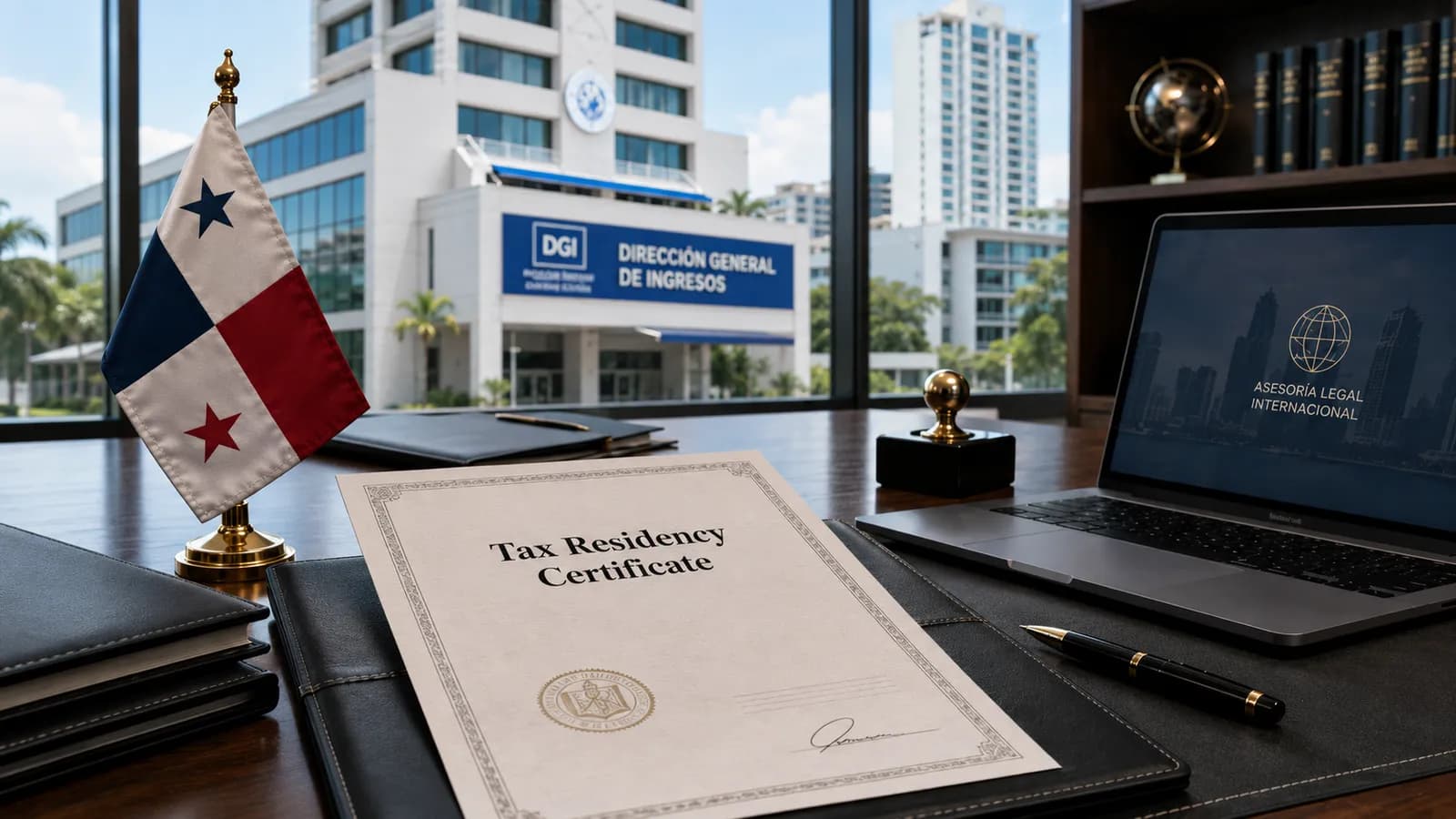
Tax Residency Certificate for Legal Entities in Panama and the New Economic Substance Law: What Changes for Panamanian Companies?

Brief overview
The Tax Residency Certificate for Legal Entities in Panama has traditionally been used to apply double taxation treaties and respond to international banks. With the new tax reform on foreign passive income and economic substance, this document takes on new relevance within the annual compliance of Panamanian companies.
Introduction
For years, many Panamanian companies requested the Tax Residency Certificate for Legal Entities only when they needed it for a specific purpose: to apply the benefits of a double taxation treaty, respond to a request from a foreign bank, comply with CRS/FATCA procedures, or demonstrate to an international counterparty that the entity had tax residency in Panama.
In other words, it was a document used primarily on a voluntary, strategic, or reactive basis.
However, the tax reform approved in Panama introduces a new compliance logic. Panamanian entities that form part of multinational groups and receive certain foreign-source passive income may be required to report such income and demonstrate adequate economic substance in Panama. The law includes as foreign passive income dividends, interest, royalties, capital gains, foreign real estate income, and other income from movable capital.
This does not mean that all Panamanian companies must request a Tax Residency Certificate. But it does mean that the documentation previously prepared to obtain that certificate —real activity, effective management, decisions made from Panama, office, personnel, accounting, and supporting documentation— can now become an essential part of the compliance file of certain companies.
What was the traditional purpose of the Tax Residency Certificate?
The Tax Residency Certificate for Legal Entities makes it possible to certify that a company is a tax resident in Panama for a given period.
In practice, companies requested it primarily for two reasons:
1. Applying treaties to avoid double taxation
When a Panamanian company received dividends, interest, royalties, or other payments from a country with which Panama maintains a tax treaty, the certificate could be necessary to request a reduction in withholding, apply treaty benefits, or demonstrate the entity's tax residency to the foreign authority.
2. Requirements of international banks, custodians, or brokers
Foreign banks, financial institutions, investment platforms, and custodians often request evidence of tax residency for compliance, CRS, FATCA, due diligence, and tax classification of the account.
According to the DGI (Panama's tax authority), the requirements for the Tax Residency Certificate for Legal Entities include a brief with power of attorney granted to a lawyer, the company's general details, the type of activity it carries out in Panama, the treaty or general use for which the certificate is requested, the year requested, and other evidence of connection with Panama.
What changes with the new law
The new reform does not eliminate the Panamanian territorial system. Panama maintains its territorial principle. However, it introduces a relevant exception: certain Panamanian entities of multinational groups that obtain foreign passive income must report it and certify economic substance in Panama in order to retain the corresponding tax treatment.
The law provides that, in order to be considered a qualified entity, the company must demonstrate elements such as adequate human resources, adequate facilities, strategic decisions adopted in Panama, risks borne in Panama, and adequate operating expenses within the national territory.
If the entity does not report, reports only partially, fails to demonstrate economic substance, or presents false information or information inconsistent with the reality of its activities, assets, risks, human resources, facilities, or operating expenses, it may be considered a non-qualified entity. In that case, the foreign passive income may be subject to a single, definitive tax of 15% on net taxable income, without prejudice to fines, surcharges, and interest.
The connection between the certificate and the new substance obligation
The Tax Residency Certificate and the new law are not exactly the same thing.
The certificate serves to prove tax residency before an authority, bank, or counterparty.
The new law requires entities to report and demonstrate economic substance for certain foreign passive income obtained by Panamanian entities within multinational groups.
But in practice both analyses are connected because they require similar evidence:
where the company is managed;
who makes the decisions;
whether there are meetings, minutes, or resolutions in Panama;
whether there is an office, lease agreement, or infrastructure;
whether there are local human resources or suppliers;
whether adequate accounting and records are kept;
whether there is real evidence of activity or management in Panama;
whether the structure has a valid commercial reason.
Previously, a company might not prepare this documentation unless it needed to request the certificate. Now, if the company falls within the scope of the new law, it may need an annual supporting file even if it does not formally request the Tax Residency Certificate.
Strategic decisions from Panama and immigration planning
One of the most relevant elements of the new regulation is that economic substance does not depend solely on having a registered company, a resident agent, accounting, or a virtual office. The law requires that, where applicable, the strategic decisions necessary for operations be adopted in Panama and that the entity be able to demonstrate adequate human resources, facilities, direction, control, risks, and operating expenses within the national territory.
For this reason, when the directors, administrators, board members, ultimate beneficial owners, or key persons of the structure are foreigners who actively participate in decision-making from Panama, it may be advisable to evaluate an appropriate immigration and labor strategy. Obtaining immigration residency in Panama —for example, under categories such as Friendly Nations or Qualified Investor, depending on the applicant's profile— can strengthen the person's legal and operational presence in the country. The National Immigration Service maintains residency categories for special economic and policy reasons, including options linked to investment and economic relations with Panama.
Likewise, if the foreigner not only participates as an investor or director, but also provides services, manages, directs operations, receives remuneration, or works on a regular basis from Panama, the need to obtain the corresponding work permit before MITRADEL must be evaluated. This review is especially important when economic substance is intended to be supported by individuals who genuinely make decisions, perform functions, or oversee assets from Panama. MITRADEL maintains specific procedures for work permits linked to Friendly Nations, permanent residents, and other immigration-related labor categories.
Consequently, economic substance planning may connect with immigration services, work permits, structuring of remuneration, local hiring, employer registration, and corporate documentation. Immigration residency or a work permit do not, on their own, replace economic substance, but they can be important pieces in demonstrating that the entity's effective management, oversight, and relevant decisions have a real connection with Panama.
Example 1: Panamanian holding company with an international brokerage account
A Panamanian company is used by an international business family to hold a brokerage account abroad. The account generates dividends, interest, and capital gains from investments in international stocks, bonds, and funds.
For years, the company only requested a Tax Residency Certificate when the foreign broker asked for it to update its compliance file or to determine the entity's tax residency under CRS.
Before the reform, the main analysis was:
Can the company demonstrate that it is a tax resident in Panama for the purposes of the bank or a foreign authority?
With the new law, the analysis can be broadened:
Is the company part of a multinational group? Does it receive foreign passive income? Can it demonstrate sufficient economic substance in Panama?
If the company is within the scope of the law, it will not be enough to have a resident agent, an accountant, and a registered address. It will need to review whether it has documentation proportionate to its activity: minutes of investment decisions, an investment policy, portfolio reports, accounting records, evidence of review from Panama, local operating expenses, an administrative provider, and support showing that the direction or control of the asset is not purely foreign.
In this case, the Tax Residency Certificate may still be useful for the broker, but in addition the company should prepare an annual economic substance file to support its tax position in Panama.
Example 2: Panamanian company providing international consulting
A Panamanian company provides strategic consulting services to a foreign company. Its income comes from fees for professional services, not from dividends, interest, royalties, capital gains, or real estate income.
In this case, the company may request a Tax Residency Certificate if the foreign client, a tax authority, or an international bank needs to confirm that the company is a tax resident in Panama.
However, the new law on foreign passive income does not necessarily apply simply because the client is abroad. Consulting is normally active income from services, not foreign passive income included in the law's list.
Even so, the company must take care of its documentation. It must be able to demonstrate a services contract, invoices, deliverables, reports, emails, evidence of the work performed, accounting, and proportionate operating substance in Panama. If the foreign client is a related party, it may also be necessary to analyze transfer pricing and the economic reality of the transaction.
This example shows an important difference:
not every Panamanian company with foreign income falls within the 15% regime.
What matters is determining the nature of the income, the source, the ownership structure, whether a multinational group exists, and whether the income is foreign passive income within the scope of the law.
Tax Residency Certificate: from a voluntary document to a strategic tool
The new law does not automatically make the Tax Residency Certificate mandatory for all Panamanian companies. But it does increase its importance as part of a compliance strategy.
For many companies, the certificate will continue to be necessary for traditional reasons: tax treaties, banks, custodians, brokers, or foreign counterparties.
For others, especially holding companies, investment vehicles, companies with brokerage accounts, foreign real estate structures, or wealth entities within international groups, the tax residency analysis must connect with a broader review of economic substance.
In practice, this means that the service should no longer be limited to "requesting a certificate." It should include a review of:
the entity's tax residency;
real activity in Panama;
effective management;
group structure;
type of income;
active income vs. passive income;
accounting documentation;
corporate decisions;
economic substance;
risks under the new law.
What a Panamanian company should review before requesting the certificate
Before requesting a Tax Residency Certificate for Legal Entities, the company should evaluate:
Real activity: what the company does and where its activity is carried out or managed.
Type of income: whether it receives active fees, dividends, interest, royalties, capital gains, real estate income, or other passive income.
Ownership structure: whether it forms part of a multinational group or is a company isolated to an individual or family.
Direction and management: where decisions are made, who makes them, and what documentation proves it.
Office and infrastructure: whether there is physical presence, a documented virtual office, a meeting room, an archive, or a local provider.
Accounting: whether it keeps adequate accounting records and supporting documentation.
Purpose of the certificate: whether it is requested for a tax treaty, an international bank, a broker, CRS/FATCA, a commercial counterparty, or general use.
Conclusion
The Tax Residency Certificate for Legal Entities in Panama remains an important tool for applying double taxation treaties, responding to international banks, and demonstrating tax residency to third parties.
The difference is that, with the new reform, the logic behind the certificate takes on greater relevance. Economic substance should no longer be seen solely as something demonstrated when a bank or a foreign authority requests it. For certain Panamanian entities that form part of multinational groups and receive foreign passive income, economic substance may become an annual obligation of reporting and documentary support.
For this reason, Panamanian companies used as holding companies, investment vehicles, foreign real estate structures, brokerage accounts, or international wealth entities must review their situation before assuming that the Panamanian territorial system applies automatically.
The best strategy is to plan ahead: prepare a coherent structure, keep adequate accounting records, document decisions, retain evidence of effective management, and evaluate whether it is advisable to request the Tax Residency Certificate as part of a comprehensive compliance file.